
The Embrace of Silence
ONE-OF-A-KIND PIECE — HANDMADE BY INDIGENOUS TRIBES IN THE HEART OF THE JUNGLE
This mask was created in a context of profound mourning.
One year earlier, Servelina’s husband died violently.
When we met, she simply told me:
“I weave to ease my pain.”
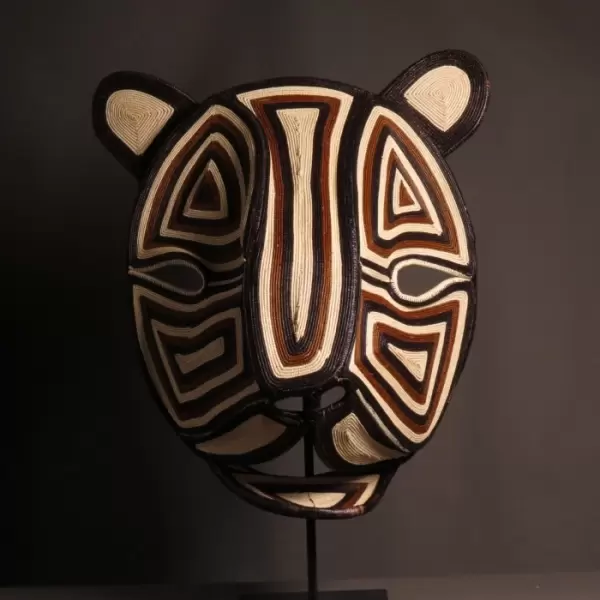
From this repeated, almost necessary gesture emerges a singular form: a monkey face with an intense expression — neither protective nor threatening.
A presence held in tension, almost unsettling.
The embroidery work is remarkable for its density and intensity. Each fiber seems to carry the emotional weight of the gesture, as if time, sorrow, and perseverance had been woven into it.
This piece does not seek to seduce.
It bears witness.
One perceives less an aesthetic intention than a process: that of transforming an intimate experience into a tangible presence.
A mask that imposes itself immediately.
A rare piece.
- Each artisan receives directly and immediately remuneration for her work, at a fair price.
- The masks all receive a phytosanitary treatment to eliminate all insect larvae.
- The dyes used are always natural and made from plants.
The masks and the invisible world
Extraordinary as works of art and decoration, these masks originate in the shamanic beliefs and rituals of the Indigenous Wounaan and Emberá peoples of Central America.
According to their beliefs, the world is divided into two realms: the visible world and a parallel, invisible world.
These invisible spirits, known as “haï”, are found in nature, in animals and plants. “The great superiority of this parallel world, this universe of shadows, is that they can see man while man cannot see them,” wrote Jean-Marie Le Clézio.
Through the shamans, people can enter into contact with the “haï” spirits of Nature.
The mask, or “nemboro”, allows the shaman, during the ritual, to take on the appearance of a spirit from the invisible world and enter into communication with it.
After the ritual, the mask that has “danced” is destroyed. It remains “charged” with the presence of the spirit, and only the shaman is permitted to touch it.
This is why no ancient examples of these ritual masks have survived.
Our masks are made using a traditional craft passed down from generation to generation.
The Chunga palm leaves, gathered in the forest, are carefully selected. The tenderest parts are harvested, dried and then bleached.
The leaves are then gathered into strands and dyed using natural dyes made from fruit, wood, seeds, leaves or roots. Several dye baths may sometimes be needed to achieve the desired shades.
The artisan does not purchase any raw materials: everything is gathered from the surrounding natural environment and then transformed by her hands.
Once this lengthy preparation is complete, the artisan begins weaving and creating the mask.
Each piece is entirely handmade, guided by her own inspiration and expertise.
One mask, one artisan. Each mask is therefore a unique piece, directly connected to the woman who imagined and created it.
Each mask bears our small metal pin, the signature of Ethic & Tropic, guaranteeing its authenticity, quality and our commitment to fair trade.
Each piece comes in a cotton pouch, accompanied by its certificate of authenticity, which includes the name of the artisan who created it.
Our masks are made from natural palm leaves and coloured with plant-based dyes.
To preserve their colours, we recommend protecting them from rain and prolonged direct exposure to sunlight.

Contact
¿Necesita más información, un presupuesto o quiere que trabajemos juntos? Escríbanos.